If you have spent any time reading blogs about Search Engine Optimization you have probably come across the term LSI keywords. Thought about what it means.. If it is just a term that people use to sound smart. You are not the one who thinks this way.What Are LSI Keywords? A Complete Beginner’s Guide for Better SEO Rankings LSI keywords are one of the misunderstood terms in Search Engine Optimization and a lot of the advice that’s out there is just not correct.
I have been using LSI keywords in my content and in the work I do for my clients since 2022. I have to say that LSI keywords have really helped me get better rankings. Not, in the way that most articles talk about it. So let us talk about what LSI keywordsre how to find LSI keywords and how to use LSI keywords without making the mistakes that most people make when they are just starting out with LSI keywords.
What Are LSI Keywords, Exactly?
What Exactly Are LSI Keywords?
Latent Semantic Indexing is an algorithm developed in the ’80s, which uses math to define how words relate to each other within a large corpus of text. This isn’t a search engine technique – the SEO community just repurposed the name and applied it to a much simpler concept.
To put it simply, LSI keywords are words and phrases related to your primary keyword through their context. These are the words you would expect to see in a piece of writing if it were to truly cover its topic.
For example, if “coffee brewing” is your primary keyword, some LSI keywords could be “French press”, “grind size”, “water temperature”, or “extraction time”. There’s no need to force these into the text – they’ll naturally arise if you know what you’re talking about.
Technicality aside, here’s a fun fact that makes the term more trustworthy. Google explicitly said in the past that they don’t use LSI – in the original, academic form of course. What they do use is related topics and language patterns, which are close enough to the definition of “LSI keywords” given by SEOs – hence the term being used to this day.
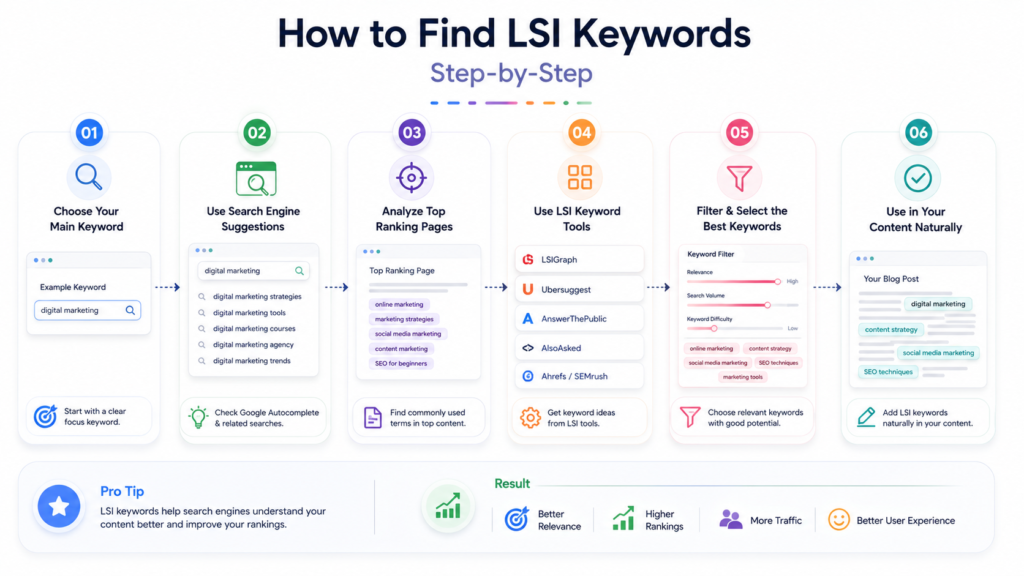
Why LSI Keywords Still Matter for SEO
Although the term may be slightly misleading, the theory remains true. The related keywords serve a number of functions:
They tell search engines that your content addresses a broad subject, rather than a very narrow aspect of it.
They allow your content to rank for more search terms than just your main keyword.They lower the possibility of keyword stuffing by giving you variation rather than repetition.
They make your content more readable since your content flows naturally rather than sounding like a machine.
Since 2022, the use of intentional related keywords in my content has proven to be one of the more effective means of increasing ranking in a consistent and long-term manner.
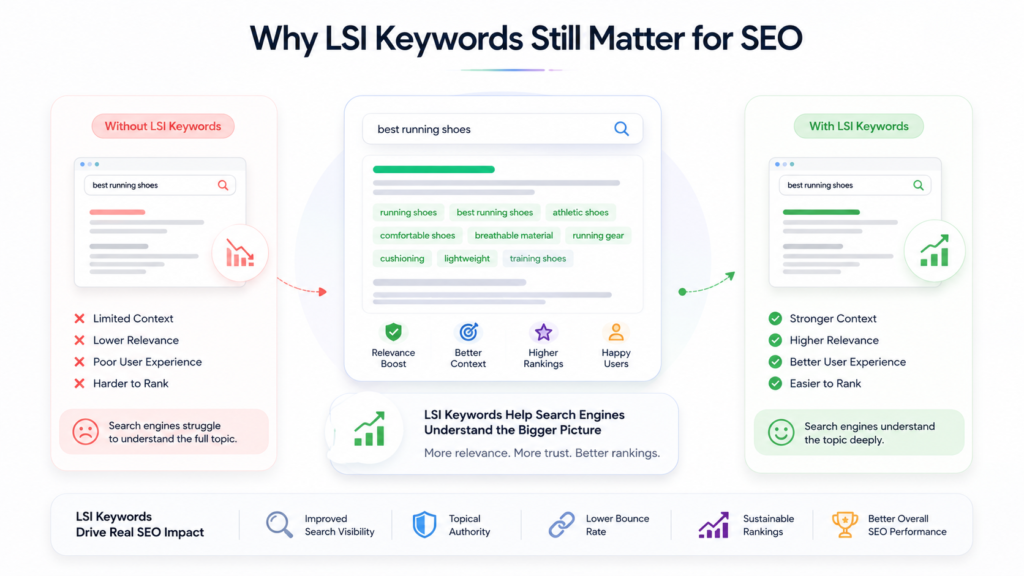
How to Find LSI Keywords (Step-by-Step)
Here’s how I actually conduct my research to identify related keywords for a particular web page:
Start by inputting your primary keyword into a keyword tool — I mainly use Google Keyword Planner and SEMrush.
Go through the suggested keywords for it. The keyword tools generate lists of terms that are searched along with your primary keyword.
Check the SERP of Google itself. Scroll down to check out the “People also ask” section as well as “Related searches” that appear at the end of the SERP — they are free.
Narrow down by filtering out irrelevant keywords. This is a step many people miss — not all keywords suggested belong in your article, and I’ll elaborate more about it below.
Organic integration into the content body. No need to force them in headings if they do not belong there — the idea is to naturally cover the keywords in your article.
Tools Comparison
Tool
Best For
Free?
Google Keyword Planner
Search volume and related terms
Yes (when you have a Google Ads account)
SEMrush
Related keywords and gap analysis
Limited searches
Google “People Also Ask”
Real user queries
Yes
Google “Related Searches”
Ideas for related terms
Yes https://www.jisnaaaaa.com
The Biggest Mistake Beginners Make
The biggest error I see, time and again, is where people take all the suggested keywords from the tool without regard to whether it relates to their subject matter.
Keyword tools work to find high-volume opportunities rather than relevance. The tool will suggest keywords simply for the reason that it comes up in the same search alongside the main keyword. Even if the suggested keyword doesn’t have anything to do with your article, using it anyway will only detract from the focus of the piece and will end up doing more harm than good.
The solution is straightforward but requires discipline; before adding any of the suggested keywords to the article, ask if an expert on the subject matter would use it.
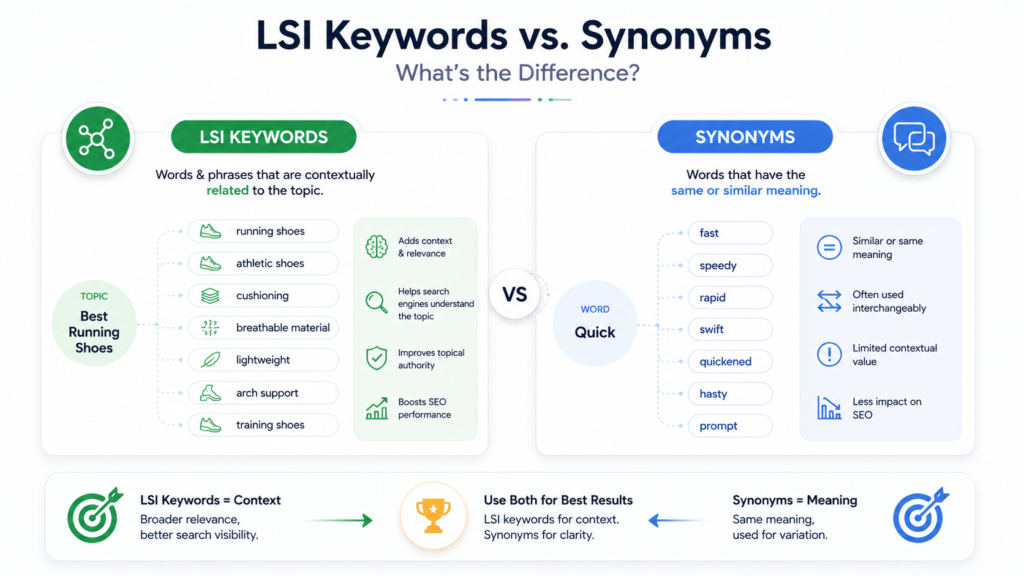
LSI Keywords vs. Synonyms: What’s the Difference?
This is something people often get confused about, so let me clear it up:
Synonyms are words that have the same meaning (such as “buy” and “purchase”).
The terms LSI keywords and related keywords refer to something completely different – these are topics related to yours contextually, but not interchangeable words (for example, “grind size” isn’t a synonym for “coffee brewing” but it is a very closely related topic).\
How Many LSI Keywords Should You Use?
This is not an absolute rule, and do not believe those who give you a precise number to work with. Instead, I usually concentrate on the natural appearance of the terms in the course of describing the topic and answering related questions. Of course, if you are writing a comprehensive article, related terms will naturally appear while explaining subtopics and answering further questions.
Nevertheless, for a 1,000-1,500 word article you should expect about 5-10 related terms and phrases appearing naturally in the body of the text.
A Quick Word of Caution
However, LSI keyword is simply a useful technique and should not be viewed as the “magic formula” to get higher ranking positions. It will not fix any problems with the website such as having poor site architecture, having thin content, or having a page which does not give the information that the user is looking for.
FAQs
Is there any relevance of LSI keywords in 2026? Yes, because topical relevancy and related keywords still remain important factors when it comes to the evaluation of content depth. In the first place, it is worth mentioning that Latent Semantic Indexing is not the actual search engine algorithm used nowadays, although the habit of mentioning related topics remains useful.
Are LSI keywords equal to semantic SEO? No, LSI keywords are the part of the process of semantic SEO optimization. Semantic SEO is the practice of producing topically relevant content; while LSI/related keywords represent one of the possible ways to achieve that goal.
Can I use the help of some online service for generating LSI keywords? Yes, services like Keyword Planner and SEMrush may help to come up with relevant keywords. However, only a person can determine whether those keywords fit a particular article.
Where do I need to place LSI keywords in my text? Within the body content.
Final Takeaways
In no way is the concept of LSI keywords some kind of black hat method of cheating algorithms; this is simply a hint on how to write the right content in which all related terms appear naturally. Find relevant terms through such tools as Keyword Planner and SEMrush, get rid of irrelevant keywords, and use them in the context.
And one more tip – do not forget that quality is better than quantity. Even when it comes to LSI keywords; a smaller number of truly relevant terms will always be better than a large number of loosely related keywords.
Internal linking opportunity: Link to your blog post about “Semantic SEO” or “How to Write SEO-Friendly Content.”
External link: Link to Google’s documentation regarding the understanding of relevance (e.g., developers.google.com/search).
Image placements:
Introduction — scheme of the main keyword and related terms (“what are LSI keywords explained”)
Step by step explanation — screenshot of Keyword Planner or SEMrush (“finding LSI keywords in SEMrush”)
Mistakes — visual examples of unconnected and connected keywords (“LSI keyword mistake example”)
Video suggestion: Screen recording while searching a keyword in SEMrush and finding related terms.